
(646) 453-4443Free Quote
Existing Customers
Looking to make a payment. Press the paypal link and enter the amount found on your invoice
If you’re trying to add a bedroom, a home office, or extra privacy to an NYC apartment without permanent construction, a pressurized wall is worth understanding. It’s a floor-to-ceiling partition that stays in place using tension alone — no nails, no screws, no adhesive. Let’s look at exactly what that means, how it works, and why it’s become the standard solution for renters who need more rooms without touching their lease or their security deposit.
A pressurized wall is a rigid, removable partition that’s held in place by tension against your floor, ceiling, and adjoining walls — not by fasteners of any kind. It’s built to the exact dimensions of the space it’s dividing, then pressed into place so it grips the surfaces around it firmly enough to function as a real wall, without ever penetrating them.
Because nothing is drilled, screwed, or glued, a pressurized wall doesn’t count as construction under NYC building code, and it doesn’t require a landlord’s sign-off the way a permanent renovation would. When it comes down, there’s nothing to patch, because nothing was ever attached.
The wall panel is built slightly taller than the space between your floor and ceiling. During installation, the crew compresses it to fit, sets it in place, then releases the compression — the panel expands back toward its full height and wedges itself firmly against the floor and ceiling. That tension is what holds it upright; there’s no separate fastening step.
Pressurized walls are used almost exclusively in residential and light commercial settings — splitting a studio into a one-bedroom, adding a home office to a living room, or dividing a shared apartment for roommates. The panel can be painted to match your existing walls, and it can include a door, a window cutout, or soundproofing insulation depending on what the space needs.
If you need more usable space in an NYC apartment and can’t (or don’t want to) commit to permanent construction, a pressurized wall solves the problem in a single day, without construction debris, permits, or risk to your deposit.
Here’s what makes it the right call for most renters:
Fast installation. A professional crew measures, builds, and installs the wall in a single visit — most jobs take a few hours, not days.
No damage. Because the wall is never fastened to your apartment, there’s nothing to patch or repair when it comes down. Your landlord has no structural change to inspect for.
No permit required. Non-structural, removable partitions like this generally fall outside NYC’s permitting requirements, since nothing about the building is permanently altered.
A pressurized wall needs to be measured and built to fit your specific space — ceiling height, floor evenness, and wall width all affect how well it seats and holds tension. This is why professional installation matters more than it might seem: a wall that’s slightly undersized or improperly compressed won’t hold securely, and a wall that’s oversized can put unnecessary stress on your ceiling or floor.
If you’re interested in getting a pressurized wall installed in your NYC apartment, contact our team today!
Pressurized walls have become one of the most common space solutions for NYC renters, precisely because they solve a real problem — not enough rooms — without construction, permits, or damage. If you’re weighing whether one is right for your apartment, it’s worth a direct conversation about your specific layout and ceiling height.
Contact us to learn more about NYC pressurized walls and other temporary walls for your apartment.
If you’ve been looking to add an extra room to create space or privacy, we have a solution for you. Try room dividers in NYC or temporary soundproof walls.
We all understand how the cost of renting an apartment around the city can be quite expensive. That’s why most people prefer adding an extra roommate to share housing costs.
Dividing a room to serve different purposes requires having a divider you can rely on. It’s also worth deciding whether you need a temporary or permanent solution — for most renters, temporary is the right call. We’d advise consulting with your landlord first either way.
Need to divide an office into several rooms for work efficiency, or split an apartment for a new roommate? You can use room dividers in NYC.
Room dividers are temporary walls that can be installed in your apartment, office, or home. They start at $2,250, up to 12 ft wide, and include a standard swing door
Room dividers use pressure instead of nails and screws to stay in place. As such, you can be sure they won’t damage your ceiling, floor, or surrounding walls.
You also have the option to paint or decorate them to match the aesthetics of your existing room.
Privacy is the obvious benefit, but there’s more to it than that. Here are the real advantages:
Cost-effectiveness. If you’re adding a roommate to help ease the cost of rent, a room divider creates separate rooms for each of you without a major investment. Room dividers in NYC are simple, affordable, and effective.
No damage. No apartment owner wants walls that damage their property. A temporary room divider uses pressure to stand upright instead of nails or screws, so there’s nothing to repair when it comes down.
Before you create that extra room, there’s one more thing worth thinking about: noise. Privacy is one thing, but peace of mind matters just as much.
Between city street noise and everyday roommate activity, sound is something every shared apartment deals with. A standard pressurized or temporary wall dampens some noise, but it doesn’t match the isolation of a permanent wall — because it isn’t directly attached to the floor, ceiling, or surrounding walls the way real construction is. That’s what the soundproofing add-on is for.
A standard pressurized wall doesn’t fully absorb noise and footfalls the way a permanent wall does. The soundproofing option solves that.
Acoustic insulation — typically mineral wool or dense foam — is built into the wall panel during installation, absorbing sound so it’s more comfortable for people on either side of the room. It adds $350 to the cost of your wall.
Because the material is inside the wall itself, you can’t tell from looking at it whether the soundproofing option was added.
Whether you want to host gatherings without disturbing a roommate or just want a quiet home office, soundproofing is worth considering.
If you’re a light or sensitive sleeper, the reduction in noise makes a real difference. And if you’re a new parent, soundproofing gives your baby’s room added protection from sound coming from the rest of the apartment.
Ready to Maximize Your Space?
Call (646) 453-4443 for a free same-day quote on a room divider or soundproofed wall.
Get a Free Quote →Creative uses temporary wall NYC renters actually build go far beyond splitting a studio into a one-bedroom. Looking for temporary wall ideas NYC apartments can actually fit? Prices start at $2,250 installed. The walls use pressure instead of nails or screws. That means you can reconfigure almost any room without touching your security deposit. Here are seven real setups we’ve installed across the city. These aren’t hypothetical ideas. They’re rooms that exist in Brooklyn and Manhattan apartments right now.
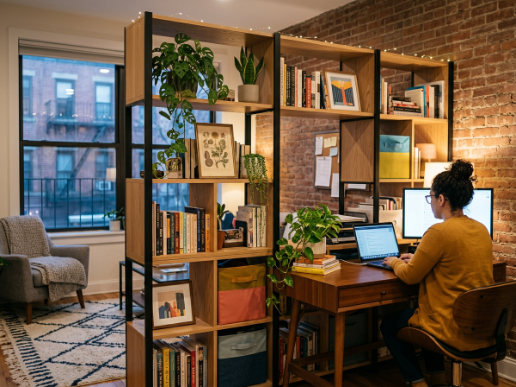
Maybe you’re picturing plywood and exposed seams. Maybe you’re picturing a fight with your landlord. That’s the wrong picture. These walls finish flush. They paint to match your existing walls. They come down clean at move-out, too. Once that fear is off the table, the real question is simple: what would you actually build with the extra room? That’s what this list is for.
Remote workers in Astoria and Long Island City have driven this use case since 2023. It hasn’t slowed down. A single wall across a living room corner, paired with a swing door, gives you a room you can close during calls. A curtain or bookshelf can’t do that. Most home office builds start at $2,250. They’re usually shorter than a full bedroom wall. One Astoria renter turned an 8-foot living room alcove into a soundproofed office in under four hours. She didn’t lose her couch or dining space in the process.
New parents in Park Slope and Crown Heights often wall off a corner of the primary bedroom into a small nursery. It skips a full renovation entirely. Because the wall can be soundproofed, it keeps a crying baby from waking the rest of the apartment at 3 a.m. That detail matters more than square footage here. This setup also means you’re not locked into a two-bedroom lease before you know how a baby actually changes your space needs.
Pre-war apartments on the Upper West Side often have long, narrow hallways that don’t do much. A short pressurized wall segment converts a dead hallway stretch into a real closet. That’s hard to find in a building from the 1920s. These builds are usually the shortest on this list — the wall segment rarely runs longer than 4 to 6 feet. Add a rod and a shelf, and you’ve got real hanging storage where there used to be empty carpet.
A temporary wall lets you section off a corner for a rack, a mat, and a mirror. No more staring at gym equipment from your couch every evening. This use case has grown alongside the home-office trend. Both come from the same root problem: apartments weren’t built with a second purpose in mind. A sliding door instead of a swing door keeps the footprint tight. That matters if your workout corner is only 5 or 6 feet wide.
This is still the most common request we get. There’s a good reason: convert studio to 1 bedroom installs often pay for themselves within a few months once you split rent with a roommate. The same wall works for renters who list a spare room on Airbnb. The new room just needs a window, or it needs to meet the NYC Department of Buildings egress requirements for a legal sleeping room.
A short pressurized wall segment can hide a pantry, bike storage, or luggage without needing a full room. This works especially well in railroad-style apartments in Bushwick. The kitchen there often opens directly onto unused floor space that never had a real purpose. Renters with bikes especially like this option. It gets a bulky item off the living room wall without paying for a storage unit across town.
Maybe family visits a few times a year. You don’t want a permanent second bedroom eating your living space for the other 50 weeks. A temporary wall is the middle ground. Put it up before visitors arrive, then take it down after. Some renters do this seasonally, which isn’t practical with a real construction wall but works fine with a pressurized one. Your apartment goes back to feeling like your own space the moment guests leave.
Not sure which setup fits your apartment? Get a free same-day quote. Most Brooklyn and Manhattan installs are scheduled within the week.
Call (646) 453-4443 Free Same-Day QuoteNot every idea on this list fits every layout. We’re not going to pretend otherwise. If you’re short on rent and have unused square footage, go with the roommate or Airbnb bedroom conversion first. It’s the only use case here that generates income instead of just improving your day-to-day life. If your apartment is already comfortable and you’re solving a specific annoyance — working from your bed, or storing a bike in the hallway — the smaller builds are faster to install.
Here’s a good way to narrow it down. Walk your apartment room by room. Note where you lose time every day: waiting for the kitchen table to be free for work, tripping over gym gear in the living room, storing off-season coats in your one closet. That daily friction points to the right apartment room ideas nyc renters actually use. It’s faster than browsing photos online. Most renters already know the answer once they frame it that way. They just didn’t realize a flex wall creative uses like these could solve it without a full renovation.
For more general layout options beyond these seven, our temporary walls for NYC home offices and co-living setup guide resources go deeper into two of the most requested configurations. We’re also expanding our NYC apartment space solutions resource and a dedicated temporary walls for Airbnb hosts guide. Both are coming soon.
Most creative-use temporary walls in NYC start at $2,250. The final price depends on size, ceiling height, door type, and whether you add soundproofing. A simple home office divider stays close to the floor price; a soundproofed nursery wall with a swing door costs more.
Yes. Pressurized and flex walls use tension instead of nails or screws. Most landlords approve them no matter what you’re using the new space for. The wall doesn’t touch your lease’s alteration clause, because it leaves zero damage when removed.
Yes. This is one of the most common uses we install. A properly built temporary wall creates a legal, private bedroom as long as it has a window or meets the building’s egress rules. That lets you add a paying roommate or list an extra room without a full renovation.
Most single-room installs take 2 to 4 hours, no matter the use case. You don’t need to move out or clear the apartment for the day. The crew works around your furniture and finishes before you’d notice much disruption.
Ready to see what fits your layout? Call (646) 453-4443 for a free same-day quote, or fill out the form below. Brooklyn, Manhattan, and Queens installs are typically scheduled within the week.
Call (646) 453-4443 Get Your Free QuoteIt didn’t take long to realize that graduating from Duke University was only the beginning of my career. I was getting job opportunities in Manhattan and knew that moving there was going to be quite expensive. Fortunately, I had two friends in the same situation, and we decided to live together to lower expenses. What I didn’t realize at the time was how pressurized walls NYC apartment dwellers use would change how we would live.
Finding a good apartment was proving to be difficult. There were several one and two-bedroom units that were affordably priced but didn’t provide much in the way of privacy. The three-bedroom units were proving to be too expensive. At first, we thought about adding to our numbers, but that would only make things even less private and comfortable, so we settled on an affordable two-bedroom apartment.
Let me tell you, the first week was a nightmare. I stayed in the living room which only meant I was awakened by every noise that was made. The lack of privacy was pretty bad, and I didn’t know how much more I could take until my buddy discovered that our complex allowed for temporary or pressurized walls. I had to ask what they were and how they could help us live affordably in Manhattan.
A pressurized wall is a temporary wall that can be placed in any room large enough to be divided. Our landlord recommended a company that had installed this type of wall before, so we looked at what they had to offer. We wound up choosing a wall that only had a door and no windows because we lived in a corner apartment. However, we could’ve chosen one that had a window and more storage space if we desired.
The installation was quick and that night I got the first good sleep since we moved into the apartment. It didn’t eliminate all the noise, but it did cut it down enough so I could relax and go to sleep. The wall itself is really indistinguishable from the other walls. We had some friends over for a get-together and one of them commented on how lucky we were to find such an affordable three-bedroom apartment.
Since the installation, we have not had one issue with the pressurized wall. It’s well constructed and I’m sure that it will last for as long as we need it. We even repainted it to match the new décor for our apartment. It’s also quite sturdy as I accidentally slipped and fell into the wall and it didn’t even budge.
Today, one of my roommates has moved to his own apartment, so we decided to rent the room out to another person. This has allowed us to keep an affordable apartment in the middle of Manhattan. For anyone who is in my situation, then pressurized walls NYC products offers a solution. Whether you need to rent out the extra space, need more privacy, or just a place to put your storage, these walls work beautifully.
Over the years, pressurized walls have always come in handy when it comes to dividing apartments. Whether it’s a family apartment or mere roommates, pressurized walls are a great option for room division without damage to the room itself. But then, NYC has improved its building codes, and there are now new rules to pressurized walls installation.
The building code for pressurized walls NYC installation has been tightened to ensure that they are never attached permanently to ceilings, floors or any surrounding walls. In as much as all new walls are subject to a permit obtained from the Department of Buildings, most homeowners have tended to avoid any form of wall permit in their space.
While some homeowners don’t like to have additional structures in your building, they also seek solutions that create a cost-effective plan. This is where pressurized walls come in handy – it creates more tenant space and lowered prices for the tenants.
Requirements for Pressurized Wall NYC Installation
While pressurized walls are a good option for homeowners and tenants, they don’t work in every space. There are basic requirements that must be observed before installing any pressurized wall. Here are some of them:
• The room must measure 80 sqft or more
• The room must have at least a window
• The room doesn’t hinder exit routes
Do well to note that the management has little or no right to allow you to install a pressurized wall until you’re given a written order. As such, it’s advisable not to sign any lease unless it permits installation of walls. This should be written in the case of any misunderstanding.
Advantages of Pressurized Walls NYC
Several reasons make pressurized walls the go-to choice of many tenants and homeowners in NYC. Here are some reasons why you should opt for a room that allows you to construct a pressurized wall.
Privacy – One of the biggest advantages of pressurized walls is optimized privacy, as roommates you don’t share literally the same room. With your personal space available, you can enjoy your privacy while having your door shut. Apparently, what happens in the next room doesn’t disturb you.
Dampens Sound – Sound travels fast, but when there’s a barrier, its speed reduces and gets dampened in some cases. This entails that when you have a pressurized wall in place, any sounds that emanate from the other room get dampened as they approach the pressurized wall. Though these walls don’t eliminate noise completely, they make it less noticeable.
Storage – Bookcase-style pressurized walls also serve storage purposes. They’re perfect for virtually any apartment. If you’re planning to stay in your apartment for a while, a bookcase wall is worth considering.
Price – A standard pressurized wall from All Week Walls starts at $2,250, installed. The exact price depends on wall width, ceiling height, and any add-ons like soundproofing or a different door type. There’s no security deposit on the wall itself — you pay for the installation, and it’s yours.
Seams or Seamless – Pressurized walls are of two primary versions; seam and seamless. If you have a strict budget, you may want to go with a standard seamed finish. If you love aesthetics, the seamless version is a better option. Seamless pressurized walls look more natural but require extra work to make them blend with the existing ceiling and walls.
French Doors – Instead of a standard swing door, a French door serves better in cases where natural light is important. A single French door adds $450 to the price, and a pocket French door adds $750 — worth it for the extra light and the finished look.
Ready to get your pressurized wall installed? All Week Walls has been installing pressurized walls across all five NYC boroughs for over 15 years — no hidden fees, straightforward pricing. Call (646) 453-4443 for a free same-day quote.
What are you waiting for? Optimize your privacy, dampen the noise, and get the extra room you need — all for a straightforward, upfront price.
For those living in the NYC area, being able to divide up an apartment through the use of temporary walls has been a godsend. Pressurized walls start at $2,250, 8 ft ceiling, up to 12 ft wide, and include a standard swing door — the final price depends on ceiling height and any add-ons like a door upgrade or soundproofing. Plus, they turn a one-bedroom apartment into a two-bedroom apartment, which means double the renters for what was one space.
Over the years, temporary walls have proven to be a cost-effective solution for those who live in apartments and want to maintain their privacy. In addition, there are also walls that provide more storage space, which may be of great concern, especially to those who share an apartment and have a limited amount of space available.
Pressurized walls nyc types
There are three basic types designed to fit the specific needs of renters or owners. Each type of wall offers certain advantages and features that should be considered before settling on a specific version. Remember to get approval from your landlord if you are not the owner of the residence before placing an order.
Pressurized walls nyc, arguably the most popular and the only type of temporary wall that touches the ceiling, pressurized walls look and function just like the real thing. It’s called pressurized because the wall itself is not directly attached to the floor, walls, or ceiling. Instead, it is pressurized so that it pushes against the surrounding structure. This keeps it in place and provides the same function as a wall built into the property itself.
Once it’s use is no longer needed, they can be removed and will not leave behind any holes, marks, or scratches. Most NYC landlords approve pressurized walls without issue, since they use no nails or screws and don’t require a permit. Some older or landmarked buildings have their own house rules on alterations, so it’s worth confirming with your landlord or co-op board before you order.
Partial: Partial walls are a lighter-touch option for roommates looking to keep their privacy without a full floor-to-ceiling build. They are similar to pressurized walls in that they do not require nails or screws to hold in place. However, they do stop about one foot or 12″ below the ceiling and often do not have a door, but a simple opening. A curtain can be used to close the empty space, but a door is not recommended. Partial walls are priced individually — call for a quote based on your layout.
Bookshelf: There are several designs available for this type of wall, which is designed primarily to create more storage space. A bookshelf wall is a structure built with attached shelving to hold all sorts of items. This means you can save space in your closet and other storage areas by having this type of wall put into place. Bookcase walls start at $3,250.
All Week Walls installs all three types across every NYC borough. Once you’ve consulted and received approval from your landlord, call (646) 453-4443 for a free same-day quote.
The Memorial Day NYC events kick off a summer of exciting activities that run through Labor Day weekend. There is something special about spending Memorial Day in the Big Apple which is why it attracts so many tourists. From concerts to events to the beauty of the city itself as summer arrives, there are many things to do in NYC at this special time of the year.
Attractions
The many year-round attractions in NYC only seem more special during Memorial Day weekend. The outdoor temperature is usually just right for the many sights to see in the city. Here are just a few places you’ll want to check out during your trip.
The four major attractions all offer great history and excellent views of how New Yorkers live every day. You might be able to catch a game at Yankee Stadium or take a tour when a game is not playing. You can also picnic in Central Park or at the Brooklyn Bridge Park and settle in for the afternoon before catching a show in the evening.
You can also take in one of the many art museums that feature several famous exhibitions and enjoy many other locations is you purchase a special Explorer Pass that may save up to 50% from the regular price of admission.
Cruises & Nature
One of the best ways to see NYC is from the water and there are several waterfront excursions you can take which will help you see what the city offers. Landmark Cruises for example takes in Battery Park, Wall Street, Statue of Liberty, One World Trade Center, the USS Intrepid, and many more sites that will let you see what helps make NYC so special to so many people.
Once you have completed your cruise, check out the American Museum of Natural History which completes some of its famed exhibitions during the Memorial Day weekend events. With so many things to see, this is one of the great places to visit during this time of the year.
Concerts
There are concerts virtually every day in NYC, but around the Memorial Day weekend the number intensifies because of the additional tourists in the area. For 2017, the Billy Joel concert at the MSG on the 25th of May will arguably be the most popular at the time and well worth seeing for residents and visitors alike.
You can also seek out concerts in the many smaller venues that NYC offers. By checking in advance, you may be able to catch a show from one of your favorite artists. Plus, the many clubs, restaurants, and bars in the city offer music acts well worth catching while enjoying a meal or a drink as you relax for the evening.
There is nothing like what Memorial Day NYC activities offer for the tourist looking to get the most out of their visit in one weekend. If you are looking to visit the Big Apple, then Memorial Day weekend is one of the best times of the year.
Published | Updated
Temporary walls are legal in NYC, generally do not require a permit, and start at $2,250 to install. That’s the short version. The longer version — what your lease actually says, what your landlord can and can’t object to, what a permit-free installation actually means, and what you’ll really pay once doors, soundproofing, and removal are factored in — is what the rest of this guide covers.
This page is the complete reference for anyone in Brooklyn, Manhattan, Queens, the Bronx, or Staten Island trying to answer three questions at once: Is this legal? Will my landlord allow it? What will it cost me? Use the Quick Facts box below for the short answers, or jump to any section for the full explanation.
Temporary walls are legal throughout New York City, provided they meet two conditions: the wall must be fully removable, and it cannot alter the building’s structure, plumbing, electrical, or fire-safety systems. A pressurized or flex wall — held in place by floor-to-ceiling tension rather than nails, screws, or adhesive — meets both conditions by design. That’s the entire legal basis for why this industry exists in a city with some of the strictest building codes in the country.
Compare that to a permanent wall renovation — adding real drywall, framing, and electrical work to a one-bedroom in Astoria or a studio in Crown Heights. That kind of work almost always triggers permitting, inspection, and Department of Buildings (DOB) oversight, because it permanently changes the apartment. A temporary wall changes nothing permanently, which is exactly why it sits outside most of that regulatory framework.
City law is one layer. Your specific building is another. Co-ops and condos often have their own house rules that go beyond city code — some require advance notice to the board even for non-structural changes, others don’t mention temporary walls at all because the rule was written before they became common. Rental buildings vary the same way: a large management company in Midtown may have a standard policy, while a small walk-up landlord in Bushwick may simply have never been asked. Legal does not always mean automatic — it means you’re not breaking the law, but you should still know your specific building’s posture before you book an install.
The legal floor is the same everywhere in the city, but how much friction you’ll actually encounter depends heavily on what kind of building you’re in. Here’s the realistic breakdown:
| Building Type | Typical Friction | What to Do First |
|---|---|---|
| Market-rate rental | Low — most large management companies (common in Midtown, LIC, FiDi) have seen this before | Quick courtesy email or call to property management |
| Small private landlord | Low to medium — depends entirely on the individual; common in Bushwick, Ridgewood, Bed-Stuy walk-ups | Explain the no-damage, removable nature directly |
| Co-op | Medium — some boards want advance notice even for non-structural work | Check house rules; notify the board in writing if required |
| Condo | Low to medium — building bylaws vary more than co-ops | Check bylaws for any “alteration” clause language |
Renters in Harlem brownstones, Inwood pre-wars, and Hell’s Kitchen high-rises all report different experiences with the exact same wall — not because the law changes, but because the person approving it does. When in doubt, asking first costs you nothing and removes any ambiguity before the crew shows up.
Not sure where your building stands?
Call (646) 453-4443. We’ve installed 5,000+ walls across NYC and know how co-op boards, management companies, and small landlords in every borough typically respond.
Call (646) 453-4443 →The NYC Department of Buildings generally does not require a permit for non-structural, removable partitions that don’t connect to a building’s mechanical systems. That covers the overwhelming majority of pressurized, flex, and bookcase wall installations. No filing, no inspector visit, no waiting weeks for approval — which is the single biggest practical advantage temporary walls have over any kind of permanent construction in this city. See the NYC DOB’s official homeowner guidance here.
There are edge cases. If a wall installation were ever combined with electrical work — running a new outlet through the partition, for example — that electrical portion would fall under separate rules. Standard temporary wall installs don’t involve that kind of work, but it’s worth knowing the line exists. For the full breakdown of permit requirements, exceptions, and how to confirm your specific situation, see our dedicated guide: Do You Need a Permit for a Temporary Wall in NYC?
Most New Yorkers’ only reference point for construction in their apartment is a permanent renovation — gut-renovated kitchens, bathroom rebuilds, work that absolutely does require DOB sign-off and can take months. It’s a reasonable assumption to carry that expectation over to a temporary wall. But the entire regulatory trigger for a permit is permanence: once you remove the permanence, you remove the reason for the permit. That’s not a loophole — it’s the same logic the city applies to plenty of other reversible changes, from temporary partitions at trade shows to pop-up retail buildouts.
A few avoidable mistakes come up repeatedly across the installs we’ve done in all five boroughs:
Standard NYC residential leases typically restrict “alterations” or “modifications” to the apartment — adding a permanent wall, repainting without approval, changing fixtures. A removable, non-destructive temporary wall generally falls outside that definition, because nothing about the apartment changes once it’s taken down. No drilled holes, no patched drywall, no altered floor plan on file with the building.
That said, “generally fine” is not the same as “guaranteed in every lease.” Some leases — particularly in larger managed buildings in Manhattan and Long Island City — include broader language that technically captures any change to room configuration, regardless of permanence. Reading your own lease before booking, rather than assuming, is the cheapest insurance you can buy. Our full breakdown of what NYC landlords need to know — and what tenants should check for — is here: NYC Landlord Legal & Code Guide.
A landlord can voice an objection, but objecting and having lease grounds to actually block the installation are two different things. Most pushback we hear about comes from landlords who are simply unfamiliar with how pressurized walls work — not from any real lease violation. Once it’s explained that the wall leaves zero permanent trace, most objections resolve themselves. For tenants dealing with a landlord who’s pushing back harder than that, our guide covers exactly where the line sits: Can Your NYC Landlord Say No to a Temporary Wall?
Some renters now sign leases for apartments specifically marketed as “flex” units — one-bedrooms pre-divided or pre-approved by the landlord for a temporary wall installation. These leases sometimes include explicit clauses about wall installation and removal responsibility. If you’re considering signing one of these, read what to check for first: What Is a Flex Wall Lease and Should You Get One?
Three variables explain almost all of the spread between the $2,250 floor and a fully-loaded install with every add-on stacked. Ceiling height matters most — newer buildings in Long Island City or Williamsburg often run 8-foot ceilings, the standard included in the floor price, while pre-war stock in Harlem, the West Village, or Park Slope frequently hits 9 or 10 feet, adding $250 or $500. Door type is next: a standard swing door is already included, a single French door adds $450, a pocket sliding door adds $300, a pocket French door adds $750. Wall width rounds it out — the floor covers up to 12 feet, and each additional foot beyond that adds $190, since every extra panel adds both material and installation time.
Most Brooklyn and Manhattan renters land at the $2,250 floor for a standard pressurized wall with a swing door. Pre-war buildings with 9–10 foot ceilings in Harlem or the West Village add $250 for a 9 ft ceiling or $500 for a 10 ft ceiling because of the extra material and labor. Soundproofing — mineral wool or dense foam insulation — adds $350 on top of any wall type. For the complete cost breakdown with every variable explained, see our dedicated pricing guide: How Much Does a Temporary Wall Cost in NYC?
A permanent wall renovation in NYC typically runs $5,000–$15,000 once you include permits, contractor labor, materials, and restoring the apartment when the lease ends — because unlike a temporary wall, a permanent one has to be undone before you move out, or you risk losing your deposit entirely. A temporary wall starts at $2,250 installed. For renters on standard 1- or 2-year leases, this isn’t a close call. The full side-by-side numbers are here: Temporary Wall vs. Permanent Wall in NYC: Costs Compared.
Get the exact price for your apartment.
Call (646) 453-4443 for a free same-day quote. Tell us your ceiling height and rough wall size — you’ll hear back within the hour.
Get a Free Quote →Two trends have pushed temporary walls from a niche workaround to a mainstream apartment strategy. First, rents across most of Brooklyn, Manhattan, and increasingly western Queens have kept climbing faster than wages, which makes splitting a one-bedroom with a roommate a far more common financial decision than it used to be — not a last resort, but a deliberate plan made before the lease is even signed. Second, the wall technology itself has improved enough that the old objections — visible seams, poor sound isolation, a divider that obviously looked temporary — mostly don’t apply anymore. A well-installed pressurized or flex wall today is difficult to distinguish from a real wall once it’s painted to match.
That combination — rising cost pressure plus better technology — is also why more buildings across the five boroughs have started treating temporary walls as a normal, expected request rather than an unusual one. Landlords and management companies that resisted the idea five years ago are increasingly the exception rather than the rule, particularly in neighborhoods with a high concentration of shared apartments like Astoria, Bushwick, and Washington Heights.
Beyond the legal and permitting questions, there’s a financial angle worth spelling out directly: a temporary wall is one of the few apartment upgrades in NYC that can pay for itself in weeks rather than years. A one-bedroom in Park Slope renting for $2,800 a month splits very differently once it’s divided into two private rooms with a roommate. Even after the cost of the wall itself, most renters recover the install cost within the first few months of shared rent — and every month after that is pure savings compared to renting a true two-bedroom at a premium.
Worked out simply: splitting that $2,800 one-bedroom two ways brings each person’s share down to $1,400 before utilities — against a comparable true two-bedroom in the same neighborhood that could easily run $3,600–$4,200 total, or $1,800–$2,100 per person. The roommate who installs a pressurized wall starting at $2,250 to create that second room is typically saving $400–$700 a month compared to the two-bedroom alternative, meaning the wall pays for itself in roughly three to six months and is pure savings for the rest of the lease.
This isn’t a new idea — renters in Bushwick, Ridgewood, and Washington Heights have been quietly doing this for years, long before “flex wall” became a marketed apartment feature. What’s changed is the quality of the wall itself: today’s pressurized and flex walls go floor-to-ceiling, block sound at something close to permanent-wall levels with the right insulation, and can be painted to match the existing apartment instead of looking like a visible divider. The privacy gain is real, not cosmetic, which is the difference between a roommate situation that works long-term and one that doesn’t.
It also works the other direction for building owners and larger landlords: apartments that can be marketed as flexible two-room setups reach a wider pool of renters — including people who’d otherwise be priced out of the neighborhood entirely — without the owner taking on permanent renovation costs or risk. That’s part of why more buildings across the five boroughs are now pre-approving or even pre-installing these walls rather than treating every request as a one-off exception.
Because the wall was never attached to your apartment in the first place, removal is fast — typically 1 to 2 hours — your landlord has no structural change to inspect for, because there isn’t one. Removal is quoted at the site measure — ask for a removal estimate at the same time as your install quote. For the full step-by-step process, see: How to Remove a Temporary Wall in NYC Without Damaging Your Apartment.
Are temporary walls legal in NYC?
Yes. Temporary, pressurized walls are legal in NYC apartments when they are removable and do not alter the building’s structure, plumbing, or electrical systems. They are a recognized, widely-used solution across all five boroughs.
Do I need a permit to install a temporary wall in NYC?
In most cases, no. Temporary walls that do not connect to a building’s mechanical systems and remain fully removable generally do not require a DOB permit. Some co-ops and older buildings may have their own internal approval process, separate from city permitting.
Can my landlord say no to a temporary wall?
A landlord can have an opinion, but most standard NYC leases do not prohibit non-destructive, removable installations. Because temporary walls leave no permanent trace, they generally do not qualify as a lease modification or alteration requiring written landlord approval.
How much does a temporary wall cost in NYC in 2026?
Pressurized walls start at $2,250. Flex walls start at $2,250 — same product, different name. Bookcase walls start at $3,250. Removal is quoted at the site measure.
What happens to a temporary wall when my lease ends?
Removal is quoted at the site measure and typically takes 1–2 hours.
Know the law. Know the cost. Get your free quote today.
Call (646) 453-4443 for a free same-day quote. Most installs across Brooklyn, Manhattan, Queens, the Bronx, and Staten Island are scheduled within the week.
Call (646) 453-4443 →For anyone struggling to live in New York City, the challenges of paying the rent can take a big bite out of your paycheck. It’s little wonder that many residents share apartment space, but that comes at the cost of privacy. One solution that is becoming more popular is the use of temporary walls NYC apartment building owners approve of using on their properties.
What are Temporary Walls?
Temporary or pressurized walls NYC apartment building owners approve are walls that divide larger rooms from floor to the ceiling without the use of nails, adhesives, or screws. It is the pressure applied from the temporary wall that keeps it in place without damaging the surrounding material. Once there is no more need for the wall, it can be taken down and not leave behind any evidence of its former presence.
Thanks to advances in technology, a temporary wall can be installed quickly and offers the same benefits as a permanent wall.
Benefits of Pressurized Walls NYC Residents Enjoy
Building codes in NYC require permanent wall added to existing apartment buildings that natural light be present in the newly created rooms. It’s one reason why many permanently added walls leave a gap near the ceiling to comply with the code, but that allows for all your activities inside the room to be heard clearly on the outside.
Temporary walls offer several advantages for both residents and building owners. The use of these walls has created mutual benefits that is making them more popular by the day.
Lower Rents: An extra room created by temporary walls NYC residents enjoy means better enticing someone to stay with you which in turn lowers the rent that you pay.
Greater Privacy: Because the walls go up to the ceiling, the noise is reduced the same as a permanent wall. This means greater privacy for people on both sides.
Creating Additional Space: This will benefit both residents and apartment building owners as a new room is created which can be rented out, used as an office, to store items, and many other uses as well.
Appeals to a Broader Demographic: The push for luxury living spaces has created fewer places for those on lower incomes to live. For property owners, creating additional rooms using temporary walls means tapping into a market that is desperate for inexpensive places to live. Plus, because the pressurized walls are temporary, they can be removed when needed.
Pressurized walls NYC residents and building owners are becoming more familiar with offer plenty of advantages with no downside. Even the price of installing a temporary wall is relatively inexpensive and often pays for itself within the first few months of renting out the new space. Plus, they do not cause any damage to the existing structure, so there is nothing to repair once they are removed.
So, if you are looking to expand the number of rentable spaces in your apartment building or if you are tired of not having any privacy when living with roommates, then getting a temporary wall installed may be the best solution.
For real estate developers, the quest for finding the hot neighborhoods that are just rising in demand has led to many developments which have struck gold or fallen flat. However, for those who are looking at finding the right housing in NYC, the key considerations should be the rent and location to transportation. In fact, those who have followed the expanding subway lines east of Manhattan have done well in the real estate market.
For Hot Neighborhoods in NYC
East Harlem: For those who prefer to stay closer, East Harlem which runs from 96th Street up to 140th that is east of Fifth Avenue is probably the place to go. The prices for homes are quite reasonable and its one of the few places in the city to find a good deal. There is some new luxury development, but it is the history and colorful neighborhood filled with cafés, restaurants, and excellent shopping that makes it a gem.
Flatbush, Brooklyn: This old neighborhood is seeing new life thanks to an influx of new residents taking advantage of the reasonable rental properties and new developments. Bounded by the Long Island Rail Road tracks to the south up to Parkside Avenue in the north, Flatbush is a well-established neighborhood that offers great shopping and plenty of other amenities.
Rockaways, Queens: Most people associate the Rockaways with surfing and hitting the beach, but thanks to the subway it’s less than an hour from Lower Manhattan which is bringing new life to this area. The beaches and more relaxed atmosphere has brought many young professionals and their families to this location. It helps that the new development is reasonably priced, especially the condos which are now rising in this neighborhood.
Sunset Park West, Brooklyn: The Sunset Park area in Brooklyn that runs along New York Harbor from Bay Ridge in the south up to Greenwood Heights is becoming a hotbed for new renting opportunities. The attractive prices combined with the pre-war buildings that have been refurbished have created a hip neighborhood full of coffee shops and café culture. The current redevelopment of the area along with reasonable rents is only bringing more people to this picturesque part of the city
It is true that these four neighborhoods will not stay in demand for long. The reasonable rates, excellent location, convenient transportation, and wealth of shopping, eating places, and entertainment will mean that many will flock to these areas in NYC. However, for every neighborhood in Brooklyn, Queens, Manhattan, and so forth that falls out of favor, there will be new ones that become hot because of lowering rent prices and an abundance of things to do.