
(646) 453-4443Free Quote
Existing Customers
Looking to make a payment. Press the paypal link and enter the amount found on your invoice
Published | Updated
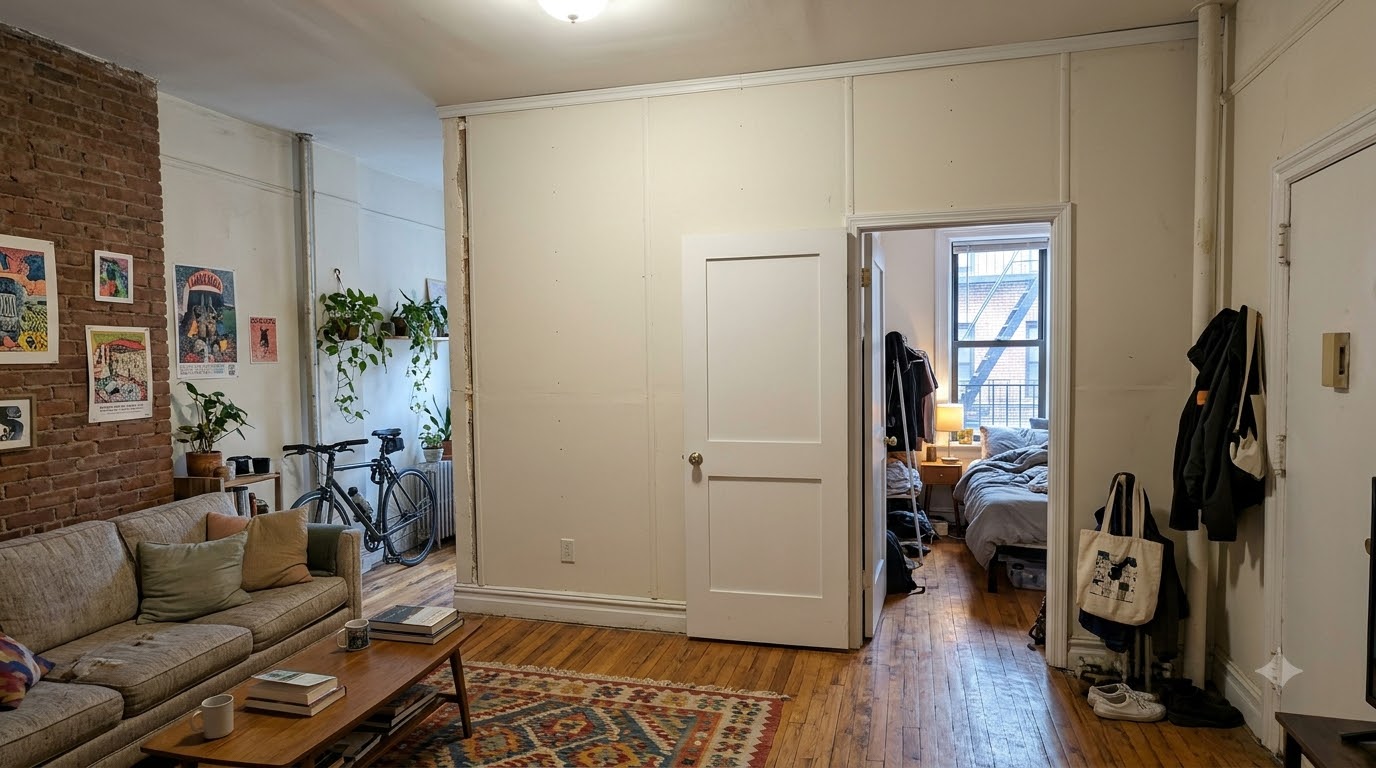
Temporary walls co-living NYC setups start at $2,250 for a pressurized wall (8 ft ceiling, up to 12 ft wide, standard swing door included). That means one shared living room becomes a private bedroom. This guide is for roommates in Bushwick, Astoria, and the East Village. They need one more room, and they want no lease fight. Prices are exclusive of sales tax.
Maybe you worry your landlord will say no. That is the most common concern we hear. In addition, co-living raises a second worry: how many people can live in one apartment? Both have clear answers. We also cover what a wall cannot do, because a few NYC rules still apply.
Most are one pressurized wall that splits a large living room in two. One side stays shared. The other side becomes a bedroom with its own door. Because the wall holds by pressure between floor and ceiling, it uses no holes and no drilling.
In New York, “co-living” means two things. First, some people rent a room from an operator in a managed building. Second, others are roommates who share a regular lease and split the rent. This guide mostly serves the second group, because operator-run buildings usually set their own layouts.
Rent explains the trend. For example, a 2026 SpareRoom study found shared rentals without a living room are almost three times as common as five years ago. As a result, more roommates give up the shared couch to cut their share of rent. However, a wall lets you keep a small shared area and still get a private room.
Sometimes. It depends on who holds the lease and what it says. Therefore, get written approval before you book anything. Here is how it breaks down:
Next, check how many people your lease allows. New York Real Property Law § 235-f says a lease signed by one tenant covers that tenant, immediate family, and one more occupant. However, a lease can set its own limits beyond that, so read yours. In addition, an unlisted roommate has no right to stay if the tenant leaves, unless the landlord agrees in writing.
For that reason, put every adult on the lease. A named tenant is protected. By contrast, an unlisted roommate is not.
For more on landlord talks, read our landlord legal guide. Likewise, our temporary wall permit guide covers the permit question.
No. A wall divides space, but it does not make a room legal. In most cases, a NYC bedroom needs 80 square feet, 8 feet each way, and a window of 12 square feet.
That matters because a wall can create a dark room. For example, a sleeping area with no window is a safety problem and a lease problem. In addition, the shared side can lose its light. So follow three rules when you place the wall:
If you are unsure, ask the NYC Department of Buildings or a licensed architect before you build. In other words, a wall is a layout choice, not a code approval.
For most Brooklyn and Queens roommates, go with a standard pressurized wall. It runs straight, spans up to 12 feet, and includes a swing door. Moreover, it costs less than the L-shaped or bookcase styles. For two roommates splitting a long living room, that makes it the right call.
Next, see our temporary walls NYC options on the homepage for every style we install.
A pressurized wall starts at $2,250 (8 ft ceiling, up to 12 ft wide, standard swing door included). In addition, soundproofing adds $350. Taller ceilings and wider spans cost more, and we quote them upfront.
Because the wall is a one-time cost, roommates can split it. For example, here is the split for the pressurized wall above:
Next, add soundproofing and the total is $2,600. As a result, three roommates pay about $867 each.
Now compare that to rent. For example, say a two-bedroom costs $4,200 a month. Two roommates pay $2,100 each. A third roommate drops each share to $1,400. As a result, each original roommate saves $700 a month, which repays a $750 wall share in about a month.
However, removal is quoted at the site measure, so ask about it with your quote. For more detail, see how much a temporary wall costs.
Want an exact price for your apartment?
Call (646) 453-4443 for a free same-day quote. Most installs are scheduled within the week across Brooklyn, Manhattan, and Queens.
These are example layouts, not customer stories. However, they show how the window and door rules play out.
Picture a two-bedroom with a living room that spans the apartment. In that case, a straight wall can create a third bedroom. If the room has two windows, split it so each side keeps one. As a result, the kitchen side and the front door stay shared.
Long rooms are the easiest to split. For instance, in an 8-foot-wide room, a wall 10 feet from the window end gives you an 80 square foot bedroom. Then check that the new room has a clear path to its door.
Some walk-ups open the kitchen straight into the living room. In that case, do not wall off the kitchen, because every roommate needs to reach it. Instead, put the wall on the far side. Use an L-shaped wall if the room has a corner. For more on where roommates live, see our NYC neighborhoods roommate wall guide.
No wall makes a room silent. However, a wall does cut sound, and you can improve it. Soundproofing adds $350 to the build. For a bedroom next to a shared living room, we recommend it.
In addition, soft furniture and rugs on the shared side absorb noise. Our guide to soundproofing a temporary wall covers the rest.
Settle this before you build, because a wall bought by three roommates gets messy when one leaves. A one-page roommate agreement is enough. In it, list who paid what, who keeps the wall, and who handles removal.
Removal is quoted at the site measure. Our walls use no holes and no drilling. Occasionally, a small amount of patch and paint work is needed after removal. Our removal guide explains the process.
Pressurized walls start at $2,250 (8 ft ceiling, up to 12 ft wide, standard swing door included). L-shaped walls start at $3,250 (up to 12 ft total run, one corner and a standard swing door included). Bookcase walls start at $3,250. Soundproofing adds $350. Prices are exclusive of sales tax.
It depends on your lease and your building. Get written permission from your landlord, co-op board, or co-living operator before you book. Our walls are freestanding and use no holes and no drilling.
No. A wall divides space, but it does not make a room legal. In most cases, a NYC bedroom needs 80 square feet, 8 feet each way, and a window of 12 square feet.
Splitting it evenly is the simplest way. A pressurized wall at $2,250 (8 ft ceiling, up to 12 ft wide, standard swing door included) costs three roommates $750 each. Put the split in a written roommate agreement.
That depends on your roommate agreement. Removal is quoted at the site measure. Occasionally, a small amount of patch and paint work is needed after removal.
Ready to price your co-living wall?
Call (646) 453-4443 or request a free same-day quote. We install in Brooklyn, Manhattan, Queens, the Bronx, and Staten Island. Most installs are scheduled within the week.
About the author
Written by the All Week Walls team. We install pressurized walls across Brooklyn, Manhattan, Queens, the Bronx, and Staten Island. Visit allweekwalls.com or call (646) 453-4443.